Sales Leadership
Systematic Selling: The CEO’s Guide to Predictable Revenue
Fix unreliable pipeline reporting and build a repeatable sales engine. Learn the systematic revenue generation strategies leading B2B enterprises use to scale.
For decades, commercial leadership has operated under a pervasive, comforting, and deeply flawed myth: To grow your business, you must hire sales superstars.
We know the type well. The heroic closer. The charisma-driven rainmaker. The high-performer who works purely on instinct, carries an impossibly thick Rolodex, and single-handedly delivers over 70% of your annual revenue target. Companies compete fiercely for these individuals, paying sky-high commissions and tolerating chaotic behavior, opaque pipelines, and zero process compliance—all in the name of the numbers.
It is an exhausting, precarious way to run a business.
When your revenue growth depends on sales rockstars, your organization isn't actually scaling but is being held hostage. If your top rep has a bad quarter, your company misses its numbers. If they get headhunted by a competitor, your pipeline walks out the door with them. Worse still, relying on rockstars creates a culture of extreme variance where 10% of the team thrives while the remaining 90% flounder, leaving leadership trapped in an endless cycle of hiring, firing, and praying for top-tier talent.
Real organizational scale does not come from finding better unicorns. It comes from building a superior system where average performers consistently produce star-level results.
This is the foundational premise of Systematic Selling.
The Rockstar Model vs. Systematic Selling
The difference between a rockstar-dependent culture and a systematic revenue engine is the difference between an individual art form and a predictable engineering discipline.When you shift from personal talent to institutional systems, the fundamental economics of your commercial team change:
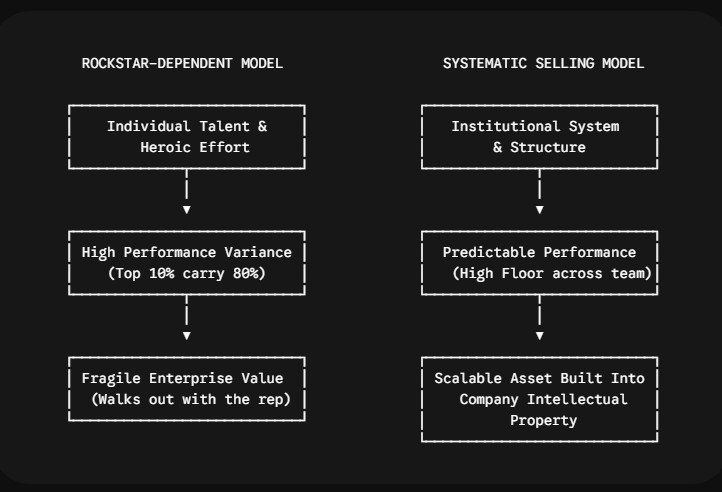
From High Variance to High Performance Floors: In a rockstar model, performance follows a brutal power law. Systematic Selling lifts the floor of performance. By giving average performers clear blueprints, diagnostic tools, and operational support, middle-tier reps achieve predictable quota attainment.
From Opaque Instinct to Transparent Process: Rockstars rarely know why they are good; they operate on intuition that cannot be documented or taught. Systematic Selling breaks down successful customer acquisitions into explicit, repeatable behaviors that anyone can execute.
From Individual Fragility to Enterprise Value: When revenue is tied to a person, enterprise value is low. When revenue is generated by a proprietary, repeatable organizational system, the value is embedded directly into the business itself.
The 8-Pillar Systematic Selling Framework
Systematic Selling is not merely a sales methodology like SPIN Selling or Strategic Selling, which offer conversational tactics or account-mapping frameworks. It is an end-to-end Organizational Revenue Architecture built on eight interconnected pillars:
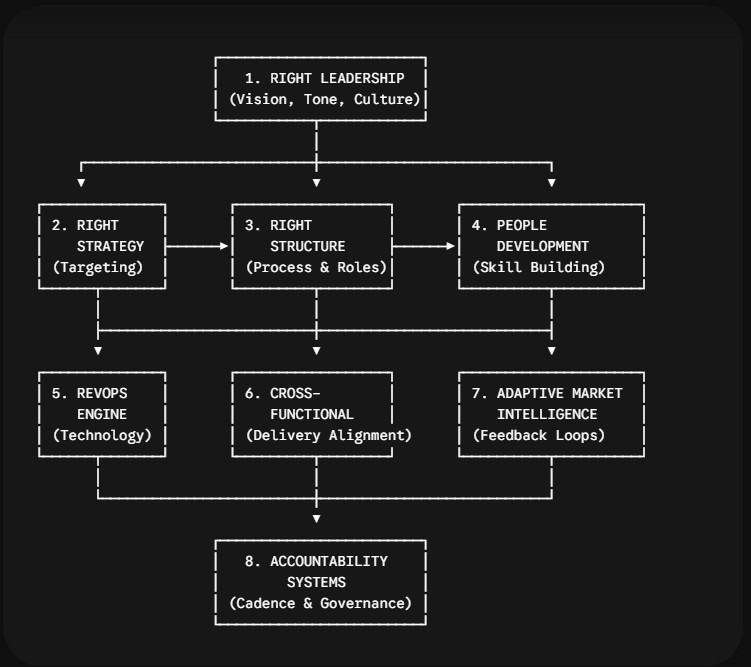
Pillar 1: Right Leadership & Cultural Guardrails
A systematic framework cannot survive under rockstar-oriented leadership. Leadership provides the cultural anchor that protects the system from shortcuts.
Process Enforcement Over Compromise: True systematic leaders refuse to tolerate "lone wolves" who hit numbers while destroying margins, ignoring CRM documentation, or steamrolling team culture.
Psychological Safety for Skill Gaps: When reps know they won't be punished for raising hand on a stalled deal, they actively engage in team problem-solving rather than hiding bad news until the end of the quarter.
System Stewardship: Leadership treats the sales process as an evolving product, constantly inspecting execution to refine tools, scripts, and workflows.
Pillar 2: Right Strategy & Ideal Customer Clarity
Average performers fail when handed vague instructions to "go open doors." The system must define the precise terrain where winning is easiest.
Rigid Ideal Customer Profiling (ICP): Clear, non-negotiable parameters defining who the company serves best—and explicit disqualification criteria for bad-fit prospects.
Quantified Value Propositions: Standardized messaging frameworks that articulate why buy, why now, and why us in financial terms (e.g., ROI, cost of delay, risk reduction) rather than generic product features.
Segment-Specific Playbooks: Distinct strategies for different market segments (Enterprise, Mid-Market, SMB) so reps never have to guess the approach.
Pillar 3: Right Structure & Specialization
Structure replaces individual talent. When roles and workflows are clearly delineated, reps spend their time executing proven steps rather than reinventing the wheel.
Division of Labor: Separating lead generation (SDRs/BDRs), deal closing (Account Executives), and client retention/expansion (Account Managers). Expecting one person to prospect, diagnose, negotiate, close, and onboard is a failure of structural design.
Verifiable Stage-Gate Criteria: Pipeline stages governed by objective buyer actions rather than rep opinions (e.g., Stage 3 entry requires a formal, signed confirmation of the client's Cost of Delay).
Embedded Value Assets: Readily accessible diagnostic playbooks, objection matrices, and ROI calculators that eliminate the need for reps to build custom presentation decks.
Pillar 4: Continuous People Development & Coaching Ramps
In traditional sales teams, training is an annual event. In Systematic Selling, skill acquisition is continuous, measurable, and integrated into daily operations.
Accelerated Onboarding Ramps: Structured 30-60-90 day onboarding frameworks that systematically transform new hires into fully functional, quota-attaining reps.
Competency Frameworks: Explicit definitions of the skills, knowledge, and behaviors required at each level of the commercial organization, establishing a clear path for career progression.
Cadenced Behavioral Coaching: Shifting manager-led reviews away from "checking status on deals" to inspecting recorded call diagnostics, roleplaying tough objections, and targeted skill development.
Pillar 5: RevOps, Tech Stack & Automation Engine
In a modern commercial organization, technology is not an administrative burden—it is the digital substrate that powers the entire system.
Frictionless Administrative Workflows: Automated logging of calls, emails, and meetings, removing manual data entry so reps spend up to 80% of their time actively communicating with buyers.
Centralized Enablement Repositories: A single source of truth for competitive battlecards, case studies, and contract templates, ensuring reps never present outdated material.
Pipeline Telemetry: Predictive CRM analytics that highlight deal velocity, buyer engagement levels, and pipeline risks automatically.
Pillar 6: Cross-Functional Alignment & Delivery Integrity
A sales engine that operates in isolation endangers customer retention. Systematic Selling connects sales directly to delivery, finance, and product operations.
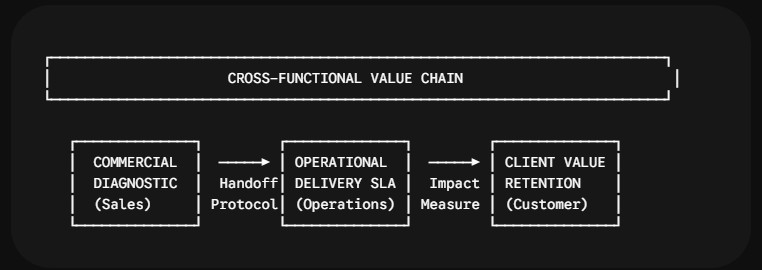
Standardized Handoff Protocols: Mandatory documentation transfer (buyer motivation, quantified pain points, key stakeholder preferences) before a deal transitions from Sales to Customer Success.
Margin & Feasibility Guardrails: Automated approval gates for non-standard pricing, custom delivery commitments, or SLA terms, protecting profit margins.
Unified Success Metrics: Aligning commercial incentives with long-term client retention and expansion, ensuring reps sell solutions the organization can execute flawlessly.
Pillar 7: Adaptive Market Intelligence & Feedback Loops
Markets evolve, competitors change pricing, and customer objections shift. A rigid system risks teaching outdated methods unless it continuously learns from the field.
Structured Win/Loss Post-Mortems: Systematic, objective post-deal evaluations conducted with buyers to uncover the true reasons behind won and lost opportunities.
Front-Line Intelligence Aggregation: Formal channels through which reps report emerging market trends, competitor tactics, and common objections back to Product and Marketing teams.
Dynamic Playbook Iteration: Regular updates to messaging frameworks, battlecards, and diagnostic scripts based on live field data.
Pillar 8: Accountability Systems & Operating Cadence
Accountability in a systematic environment is not about punitive inspection—it is about maintaining operational rhythm and visibility into leading indicators.
Leading vs. Lagging Indicator Tracking:
Lagging Metrics: Revenue closed, gross margin, win rate.
Leading Metrics: Diagnostic discovery meetings completed, mutual success plans signed, Cost-of-Delay calculations validated by prospects.
Management Operating Cadence: A strict, non-negotiable rhythm of operational reviews:
Daily: Brief 10-minute team standups focusing on immediate priorities.
Weekly: Behavioral pipeline inspections and deal-coaching sessions.
Monthly/Quarterly: System retrospectives, playbook updates, and performance calibration.
CRM as a Governance Engine: Using CRM data to govern workflow progress rather than treating it as an executive reporting database.
Systematic Selling vs. Legacy Methodologies
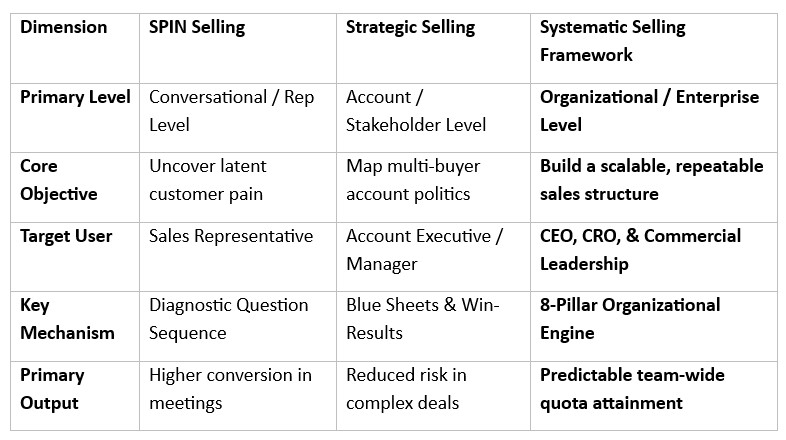
For decades, sales leaders have invested heavily in proven methodologies such as SPIN Selling and Strategic Selling. These frameworks have transformed the way sales professionals uncover customer needs, navigate complex buying committees, and improve win rates. They remain valuable tools for improving the effectiveness of individual salespeople and managing strategic opportunities.
However, today's business environment demands more than better sales conversations or more sophisticated account planning. CEOs and commercial leaders are under increasing pressure to deliver predictable revenue, accelerate growth, enhance forecasting accuracy, and build commercial organisations that can scale without relying on a handful of exceptional individuals.
This is where Systematic Selling™ fundamentally differs.
Rather than focusing on how an individual salesperson sells, Systematic Selling™ focuses on how an entire organization creates, manages, and sustains revenue. It is an enterprise-wide commercial operating system that aligns leadership, strategy, people, processes, technology, and accountability into one integrated revenue engine.
While traditional sales methodologies optimize the performance of individual salespeople or specific opportunities, Systematic Selling™ is designed to optimize the performance of the entire commercial organization—enabling average performers to consistently achieve exceptional results and transforming sales from an individual skill into a scalable organizational capability.
The comparison below illustrates the difference.
The Transformation: Moving from Heroics to Systemic Scale
Building a Systematic Selling engine requires commercial leaders to make a fundamental mindset shift: Stop searching for better people to fix a broken process, and start building a better process to unlock the potential of your people.
Organizations that make this transition experience profound shifts:
Recruiting becomes predictable: Instead of competing for elusive, overpriced rockstars, you hire coachable, competent individuals who fit your cultural profile.
Onboarding time drops: New hires reach productivity in weeks rather than months because the path to success is clearly laid out.
Valuations rise: Investors value businesses with institutionalized, repeatable revenue systems far higher than companies whose revenue depends on key-person risks.
The era of relying on sales rockstars is ending. The future belongs to organizations that build repeatable, scalable, and systematic commercial engines—where average people achieve extraordinary success, day in and day out.